
Commentaries
Measles Resurgence in the US: Children Pay the Price for Vaccine Hesitancy

November 21, 2026
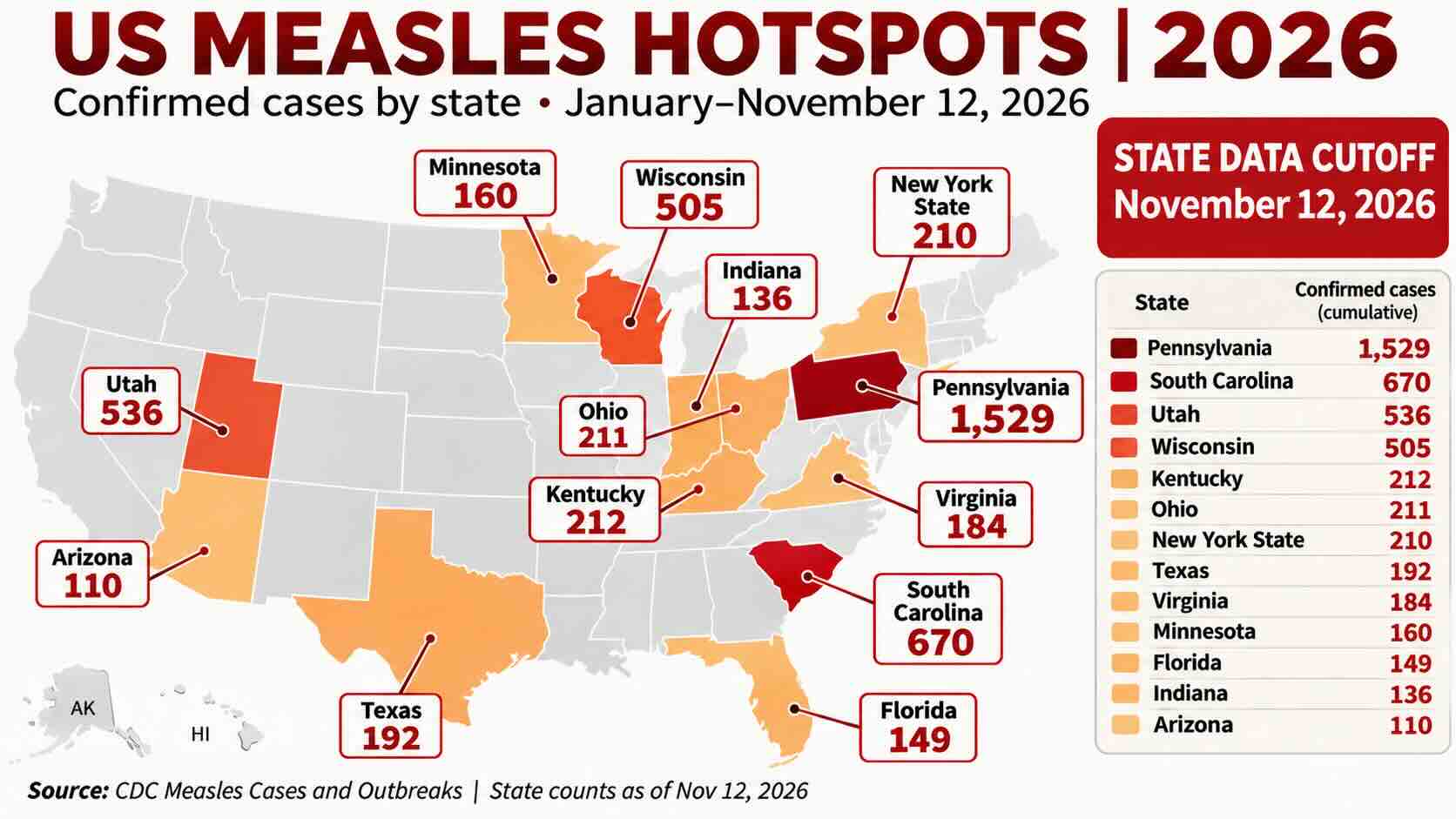
Measles has once again become endemic in the United States (US). The country achieved measles elimination in 2000, defined as interrupting continuous domestic transmission for at least 12 months. This public health achievement was made possible by an effective vaccination programme, sustained surveillance, and outbreak-control efforts.
On November 17, 2026, the Pan American Health Organization (PAHO) announced that the US had lost its measles elimination status after 26 years. Measles cases in North America have already surpassed the 2025 total. Bolivia and Mexico also lost their measles elimination status, along with the US. A review found that a single chain of transmission, which began in January 2025, continued for more than 12 months. According to the Centers for Disease Control and Prevention (CDC), the US recorded 5,412 measles cases in 2026 as of November 12, compared with 2,289 for all of 2025. The CDC also reported six deaths and 591 hospitalizations among the 2026 cases, although these figures are still provisional.
From 2000 through 2024, the United States reported fewer than 100 cases per year. However, vaccine skepticism and declining childhood vaccination rates have contributed to the disease’s resurgence, with serious consequences. Approximately 92% of kindergartners received the measles, mumps, and rubella (MMR) vaccine during the 2025-2026 school year. Some states have reported vaccination rates as low as 75%. A vaccination rate of at least 95% is considered necessary to maintain herd immunity. The virus has now been circulating for an extended period, placing families and communities at risk of an otherwise preventable illness.
Scottish physician Francis Home demonstrated in 1757 that measles is caused by an infectious agent in patients' blood. In 1912, measles became a nationally notifiable disease in the US. During the first decade of reporting, an average of 6,000 deaths were recorded each year. The vaccine for this disease became available in 1963. In the US and many parts of the world, until the 1950s/1960s, nearly all children contracted measles by age 15.
In 1978, the Centers for Disease Control and Prevention (CDC) set an ambitious goal to eliminate measles from the US by 1982. By 1981, reported measles cases were 80% lower than the previous year. However, in 1989, a measles outbreak occurred among vaccinated school-aged children. As a result, a second dose of the MMR vaccine was recommended for all children.
It is unfortunate that a technologically advanced and progressive country like the US has reached a point where a disease like measles is being described as endemic once again. To date, there is no specific treatment for measles, and timely vaccination is the only option. Unfortunately, acceptance of MMR vaccination has fallen over the years. This has happened despite warnings from epidemiologists and infectious disease physicians in the US. This is not only a public health failure but also a disturbing erosion of scientific awareness and public responsibility. There is little understanding that vaccination protects individual children from measles and also contributes to community immunity.
Vaccine hesitancy in the US is not a recent phenomenon. In the 1990s, there was significant focus on the possible adverse effects of vaccination. Much of the news coverage centered on the publication of Andrew Wakefield's now-discredited 1998 study in The Lancet, which falsely suggested a link between the MMR vaccine and autism. Autism, medically known as autism spectrum disorder (ASD), is a lifelong neurodevelopmental condition that affects how a person communicates, interacts socially, and experiences the world.
In general, in the US, vaccine coverage has declined due to COVID-19-related disruptions to immunization programs and rising vaccine hesitancy. This is fuelled by anti-vaccine movements and misinformation spread through social media and unverified news. Hesitancy may stem from vaccine-specific misconceptions (e.g., the disproven MMR-autism link), concerns about potential side effects or ingredients such as thimerosal, fear of needles, or apprehension toward newly developed vaccines, including COVID-19 vaccines.
Faiths and beliefs could also contribute to vaccine hesitancy in some segments of the population. However, a more serious concern arises from sections of the political and policymaking community that openly promote or endorse anti-vaccination positions.
During his first term, President Donald Trump made several remarks in 2020 suggesting that COVID-19 would go away even without a vaccine and that reopening should proceed regardless of vaccine availability. A CNN tracker documented at least 38 instances between February 2020 and October 10, 2020, in which Trump stated that COVID-19 would disappear or was disappearing, even as cases and deaths continued to rise. During his current (second) term, Trump signed an Executive Order on February 14, 2025, prohibiting federal funding for schools and educational institutions that mandate COVID-19 vaccination for in-person attendance.
During Trump 2.0, the administration has raised concerns about the future of global health. It is unfortunate that the US is no longer a part of the World Health Organization (WHO). Funding cuts have also been made to various health agencies in the US. The appointment of Robert F. Kennedy Jr. as Secretary of Health on February 13, 2025, raised concerns about the potential impact on various public health programs, given his longstanding reputation as a prominent vaccine skeptic. However, in response to the ongoing crisis, he appears to have adopted a more supportive stance toward vaccination.
The loss of measles elimination status in the US serves as a stark reminder of how the fallout of vaccine hesitancy can create health emergencies. For the US administration, it is important to make people aware of the importance of trusting medical science. Politicians and policymakers also need to ensure that their personal beliefs do not get in the way of public health.
The resurgence of measles in the US also raises wider public health and biosecurity concerns. As a highly contagious disease, measles can spread rapidly across communities and national borders, particularly where vaccination coverage is inadequate. Although it is primarily a public health concern rather than a deliberate biological threat, its resurgence exposes gaps in disease surveillance, preparedness and risk communication. The loss of measles elimination status should therefore serve as a wake-up call for US authorities to address vaccine hesitancy, counter misinformation, and restore public confidence in science-based health policies. More importantly, it underscores the need to sustain vaccination coverage and strengthen public health systems to prevent the return of diseases that were once brought under control.
Selected sources
- PAHO, “PAHO urges countries to step up efforts to stop measles outbreaks and move towards elimination in the Americas,” November 17, 2026: https://www.paho.org/en/news/17-11-2026-paho-urges-countries-step-efforts-stop-measles-outbreaks-and-move-towards
- U.S. officially loses measles elimination status in a body blow to public health, Scientific American, November 17, 2026: https://www.scientificamerican.com/article/u-s-officially-loses-measles-elimination-status-in-a-body-blow-to-public-health/
Group Captain (Retd.) Dr. Ajey Lele, Deputy Director General, The Manohar Parrikar Institute for Defence Studies and Analyses (MP-IDSA), New Delhi. Views are personal.